



Veel winkeliers en groothandelaars verliezen omzet doordat ze geen gestructureerde workflow hanteren voor restpartij doorverkopen. 60% van KMO’s verliezen omzet door inefficiënte voorraadprocessen, wat kapitaal bindt en magazijnkosten opdrijft. Dit artikel biedt een praktische workflow waarmee u uw restpartijen systematisch kunt doorverkopen, uw voorraadomzet versnelt en uw winstmarge optimaliseert. Kooistra.com As a market leader since 1979, we support these processes with reliable partners and professional guidance.
| Punt | Details |
|---|---|
| Efficient workflows increase revenue | Structured processes lead to a 15-25% revenue increase within 6 months. |
| Digital tools reduce losses | Software increases efficiency by 20-30%and reduces inventory loss to below 5%. |
| Optimising pricing to boost sales | Competitive pricing shortens lead times without harming margins. |
| Secure storage prevents damage | Controlled warehouses protect stock from damage and theft. |
| Alternative methods offer trade-offs | Bulk sales are fast but yield less than auctions, which require more organisation. |
Before you start reselling, you need to get the fundamentals in order. Market knowledge is essential for correctly estimating demand and prices. You need to know which products sell well in your region and which suppliers you can purchase from through specialised channels such as Insights into residual stock.
Digital administration forms the basis of efficient stock management. Use software that provides real-time insight into stock levels, sales speed, and profit margins. Without digital systems, you will lack an overview and fall behind with decisions.

Legal compliance cannot be ignored. European trade legislation sets requirements for product information, safety, and guarantees. Ensure your remaining stock complies with CE marking, product labels, and other mandatory standards. This prevents legal problems and protects your reputation.
Essential preparation points:
Access to reliable suppliers makes the difference between profitable and loss-making deals. Kooistra.com Offers controlled lots since 1979 with transparent prices and fast processing. Their 15,000 m² warehouse guarantees stock and variety.
Good storage capacity is essential. You need space that is secure, dry, and easily accessible. Poor storage causes damage that harms your selling price and reputation. Invest in solid shelving, climate control, and security systems.
A systematic approach maximises your returns and minimises risks. Follow these steps consistently for every batch of residual stock you purchase.
Inspection and quality control upon receipt
Check each consignment immediately upon delivery. Count quantities, inspect packaging, and test a sample of products for functionality. Document any damages and shortages with the supplier immediately.
2. Determining pricing strategy
Calculate your cost price including purchasing, transport and storage. Analyse market prices of similar products via online platforms and competitors. Set a competitive price that sells quickly but protects margins, usually 20-40% below retail price.
3. Digitising stock
Enter all product details into your inventory management system: EAN codes, dimensions, condition, and location. Software increases resale process efficiency by 20-30%, Which saves time and reduces errors. Take high-quality photos for online sales.
4. Active marketing and sales
Publish your offers on multiple channels such as your webshop, B2B platforms, social media, and newsletters. Proactively approach existing customers with offers that match their profile. Workflow for reselling remaindered stock at Kooistra.com presents proven multichannel strategies.
5. Secure storage and optimised logistics
Organise your warehouse with logical zones per product category. Place fast-selling items close to the dispatch department. Implement a FIFO system to sell older stock first. Monitor Wholesale buying tips for warehouse optimisation.
6. Monitoring of results and process optimisation
Analyse your sales figures, stock rotation and profit margins weekly. Identify slow movers and adjust prices or marketing accordingly. Use dashboards to monitor KPIs such as average lead time and sell-through rate.
| Process step | Time investment | Critical success factor |
|---|---|---|
| Inspection and control | 2-4 hours per game | Full state documentation |
| Pricing strategy | 1-2 hours | Market analysis and cost calculation |
| Digitalisation | 3-6 hours per batch | Accurate product data and photos |
| Marketing | Continuous | Multichannel approach |
| Storage and logistics | Daily | Efficient warehouse layout |
| Performance monitoring | 2 hours per week | Real-time dashboards |
Pro-tip: Collaborate with specialists Clearance stock buyers like Kooistra.com for complex parties. They buy large volumes at fair prices, drastically reducing your lead times and freeing up warehouse space for new deals. Their expertise in Logistics and shipping options ensures rapid processing without operational headaches.
The correct inventory management software study shows that integrated systems make the difference between profitable and loss-making resale. Choose software with API connections to your sales channels and accounting.
Even experienced traders make mistakes that cost them profits. Recognise these pitfalls and actively avoid them.
Lack of digital administration
Manual registration leads to lost stock, duplicate orders and missed sales. Implement a digital system from day one that links inventory, sales and finances. The investment will pay for itself within weeks.
Insufficient marketing effort
Stock clearances don't sell themselves. You need to actively approach customers, be visible online, and run regular promotions. Set aside time each week for marketing activities. Without promotions, stock will remain unsold, and you'll lose capital.
Unsafe storage increases damage
Damaged products are unsaleable or require heavy discounts. Invest in sturdy shelving, moisture control, and security cameras. A stolen or damaged batch will completely destroy your profit margin.
Incorrect pricing
Excessively high prices slow sales, while excessively low prices destroy margins. Conduct thorough market analysis and test prices. Start competitively and increase if demand is high. Monitoring competitors helps to establish realistic prices.
No quality control on receipt
If you discover damage or shortages only after weeks, you will no longer be able to make a claim against suppliers. Inspect every delivery within 48 hours and document everything with photographs and signatures.
Pro-tip: Know from the Error prevention for residual batches by regularly evaluating your processes. Organise monthly review sessions with your team to identify bottlenecks and implement solutions. Small adjustments cumulate into large efficiency gains.
Measurable KPIs show whether your workflow is effective. Set realistic goals and monitor them consistently.
Increased revenue through structured processes
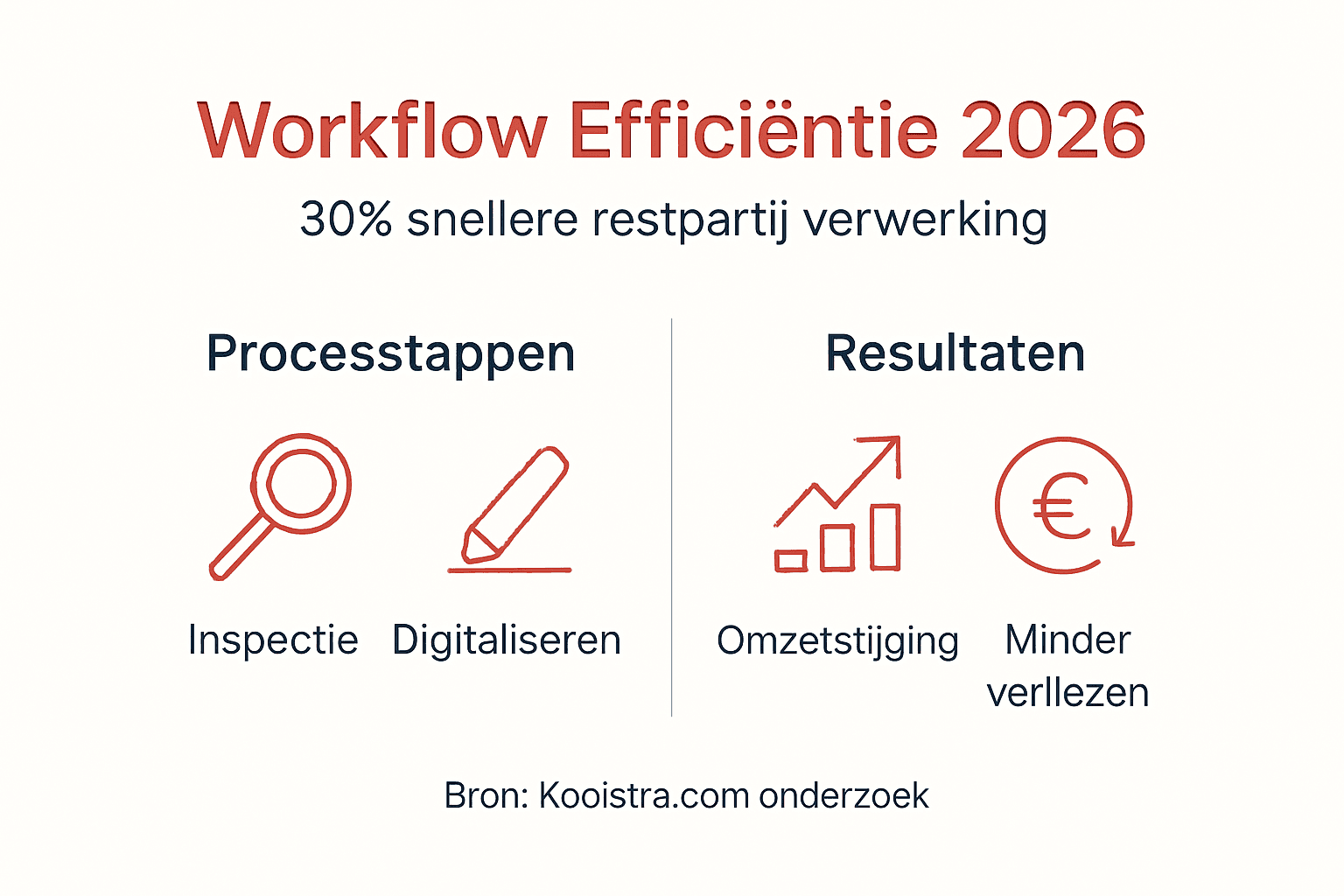
Companies that implement a systematic workflow see a revenue increase of 15-25%within 6 months. This is due to faster inventory turnover, better pricing, and reduced losses from damage or spoilage.
Inventory circulation lead time
Aim for an average lead time of 4-8 weeks from procurement to sale. Longer periods tie up capital and increase storage costs. Faster turnover maximises return on invested capital.
Sales percentage within the quarter
U moet 65-75% van uw ingekochte partijen binnen 3 maanden verkopen. Lager percentage duidt op slechte inkoop, zwakke marketing of verkeerde prijzen. Analyseer welke productcategorieën achterblijven en pas uw strategie aan.
Inventory loss reduction
Professional workflows reduce losses from damage, theft, and obsolescence to less than 5% per year. This requires good storage, accurate administration, and proactive sales of slow-moving items.
Efficiency improvement through software
Digital tools increase process efficiency by 20-30%, which translates into lower staff costs and faster processing. You save hours of administration per week.
| Key Performance Indicator | Target value | Meeting frequency | Action on deviation |
|---|---|---|---|
| Turnover increase | 15-25% YoY | Monthly | Analyse marketing and pricing |
| Inventory lead time | 4-8 weeks | Weekly | Increase promotion or reduce price |
| Sales percentage 3 months | 65-75% | Monthly | Review of procurement and product mix |
| Stock loss percentage | <5% per annum | Quarter | Improve storage and control |
| Process efficiency | +20-30% | Quarter | Optimise software usage |
Systematically follow these success metrics for reselling residual stock. Create dashboards that provide real-time insight into your key metrics. Discuss results weekly with your team and adapt tactics where necessary.
Benchmark your results against industry standards and fellow traders. Kooistra.com regularly shares market insights that help you set realistic goals. Their experience since 1979 offers valuable perspective on what is achievable in different market segments.
Different methods suit different situations. Understand the pros and cons to make the right choice.
Direct bulk sales to wholesalers
You sell complete batches in a single transaction to other wholesalers or retail chains. This is quick and requires minimal organisation. The trade-off is a lower return, often 30-50% below what you would achieve through retail.
Auctions and bidding systems
Auctions often generate higher prices through competition between buyers. You reach a broad audience and sell quickly. Disadvantages include organisation costs, unpredictable returns and complex logistics for transport to different winners.
Gradual retail resale
You sell items one by one through your webshop or physical store. This maximizes prices but requires more time, marketing, and storage capacity. Suitable for high-value products with good margins.
| Method | Speed | Yield | Organisation | Ideal for |
|---|---|---|---|---|
| Direct bulk sales | 1-2 weeks | 50-70% of retail | Low | Large volumes, low margins |
| Auctions | 2-4 weeks | 70-90% of retail | Average | Diverse parties, broad audience |
| Retail resale | 2-6 months | 80-100% van retail | High | High-quality products |
| Hybrid approach | 1-3 months | 65-85% of retail | Average | Mixed parties |
The choice depends on your specific situation:
Kooistra.com uses a hybrid model whereby they sell large volumes through alternative resale methods. Their expertise helps you find the right balance between speed and yield for your specific batches.
Also consider the impact on your customer base. Direct sales to end customers build loyalty and repeat purchases. Bulk sales to wholesalers are anonymous but efficient. Your strategy should align with your long-term business goals.
An efficient workflow for reselling surplus stock requires expertise, time and the right partners. Kooistra.com offers reliable support to retailers and wholesalers looking to maximise their stock turnover since 1979.
Hun breed restpartijen aanbod bij Kooistra.com encompasses diverse product categories from overstock to returned goods, all carefully checked and transparently priced. With 15,000 m² of warehouse space, they guarantee availability and fast delivery throughout Europe.
Kooistra.com takes over complex lots at fair prices, freeing up your capital without operational hassle. Their experience in the overstock market prevents costly mistakes and increases your profitability. Direct payment and professional handling make collaboration easy.
For retailers who want to Save with wholesale offers Kooistra.com sharp purchase prices that protect your margin. Their team understands the challenges of stock optimisation and actively contributes to strategic purchasing.
Conduct a systematic inspection within 48 hours of receipt. Check packaging for damage, test a sample of at least 10% of the products for functionality, and document all findings with photographs. Use a standard checklist with criteria such as working condition, completeness, cosmetic condition, and salability.
First, analyse your total cost price including purchasing, transport and storage. Then, research market prices via comparable offers on B2B platforms and retail channels. Set your price 20-40% below regular retail prices to be competitive, but protect at least a 15-20% net margin after all costs.
Choose software with real-time inventory tracking, multichannel integration, and automatic reporting functionality. Systems such as TradeGecko, Cin7, or local ERP solutions offer API links to webshops and marketplaces. Essential are barcode scanning, FIFO tracking, and dashboards with KPIs such as inventory turnover and sales speed.
Implement security cameras, access control and fire detection in your warehouse. Use sturdy shelving with clear labels and FIFO marking. Take out adequate insurance for stock and buildings. Organise daily inspection rounds and train staff in safe handling of goods to prevent damage.
Aim for a 15-25%% revenue increase within 6 months of implementing a structured workflow. Your average inventory lead time should be 4-8 weeks from purchase to sale. Set a target to sell 65-75%% of each batch within 3 months, with a maximum of 5%% loss due to damage or obsolescence per year.

After evaluating your offer, you will receive an immediate offer. We are flexible and proceed quickly. Bid - Pay - Collect.

We are the partner for reselling batches of goods outside your own sales market.

We are financially sound and we have the capacity to buy up sizeable consignments of goods.

We buy the whole lot and make no selection here. Large, small and mixed lots. We buy everything in the field of consumer goods!


