



You've found an attractive lot of stock, but you're unsure if the investment will be profitable. Many retailers and wholesalers lose money by buying impulsively without thorough preparation. This guide offers concrete strategies to minimise risks and maximise profitability when purchasing surplus stock. You will learn to recognise common pitfalls, apply effective preparatory steps, and implement smart sales methods. With the right approach, you can transform excess stock into a profitable opportunity for your business.
| Punt | Details |
|---|---|
| Risk management | Batch inconsistency and brand restrictions require careful examination prior to purchase. |
| Preparation is crucial | Planning for storage and sales prevents financial losses and unsaleable stock |
| Strategic procurement | Checklists and quality controls optimise profitability and reduce storage costs |
| Assess marketability | Seasonal items and market demand determine whether a deal becomes profitable. |
| Preventing errors | Thorough checks eliminate problems with backorders and product consistency |
Clearance stock offers attractive margins, but often hides unexpected complications that can undermine your profitability. Many entrepreneurs underestimate the complexity of this purchasing method and pay a high price for it.
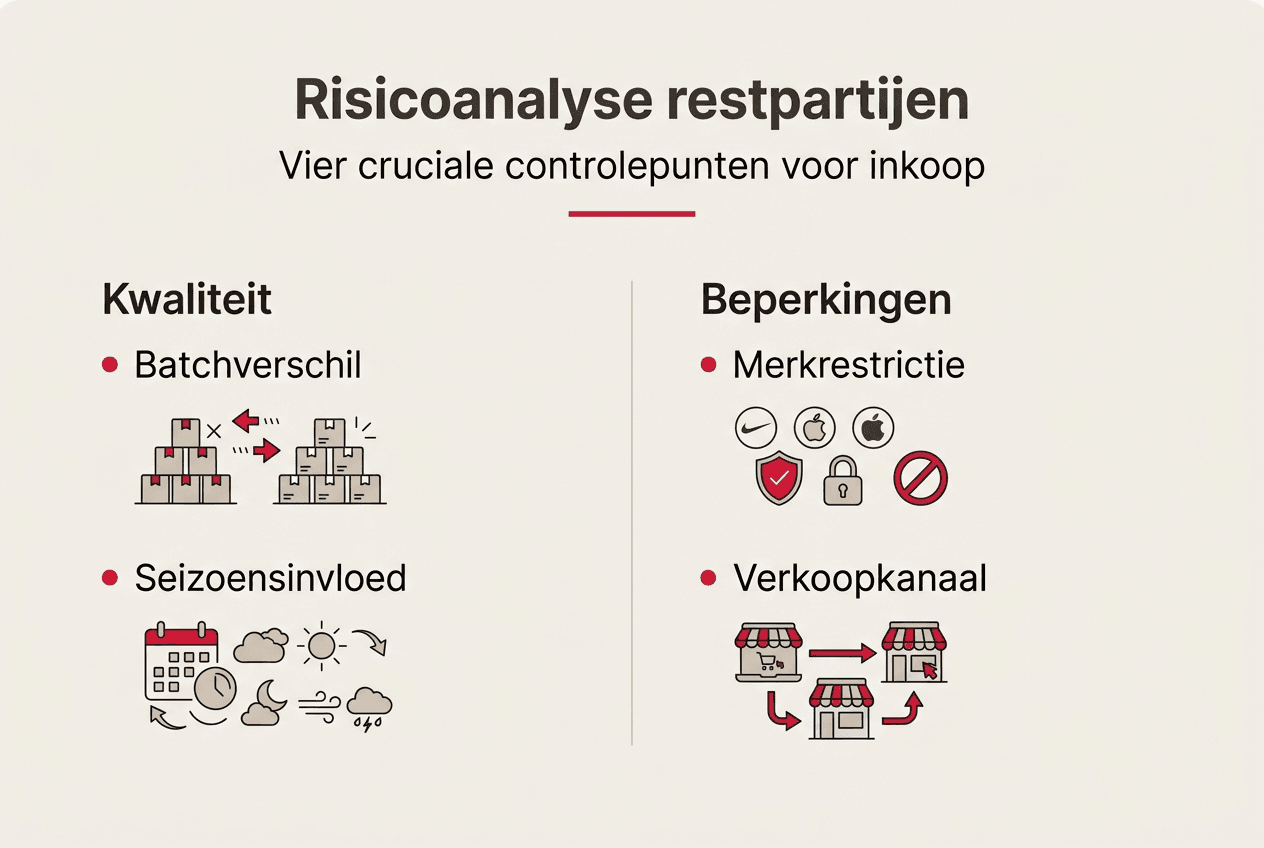
The biggest pitfall is acting impulsively when a party seems cheap. Risks include colour or batch inconsistency, non-matching accessories, seasonal items that are unsaleable, and brand restrictions.. A batch of winter coats bought in April can occupy valuable storage space for months before you can sell them. Batch inconsistency means colours or sizes don't match, leading to customer dissatisfaction or increased returns.
Brand restrictions are another critical point of attention. Some suppliers prohibit online sales or impose geographical limitations. You purchase a batch of branded clothing, only to discover that you are contractually bound to specific sales channels. This drastically limits your sales opportunities and can disrupt your business model.
Seasonal influences demand strategic thinking. Buying garden furniture in October might seem clever due to low prices, but you have to wait eight months for the optimal sales period. During that time, you'll incur storage costs and tie up your capital. Always calculate the total cost price, including storage, before making a decision.
Pro tip: conduct a risk analysis for every potential purchase with four categories: product quality, seasonality, brand restrictions, and sales channels. Assign each a score and only purchase when the total is acceptable.
The clearance sale certain specific challenges that require in-depth knowledge. A lack of reordering options means you have to estimate exactly how much you need. Buying too little leads to lost revenue, too much results in dead stock. This balance requires experience and market insight.
Critical risk factors
Always physically inspect samples before committing to a full batch. Photos and descriptions rarely tell the whole story. Inquire about the original seller's return rates and reasons for overstock. This information often reveals hidden issues.
Successful residual stock purchasing begins weeks before you make an offer. Thorough preparation separates profitable deals from costly mistakes. You need a systematic approach that encompasses all aspects from procurement to sales.
Begin with a thorough inventory of your current situation. How much storage space do you have available? Which products fit with your existing product range? What is your available purchasing budget, including a buffer for unexpected costs? These basic questions will determine which suppliers are realistic for your situation.
Planning aids in the storage and sale of residual stock, which is essential to prevent losses. Create a detailed timeline from receipt to expected sale. Calculate monthly storage costs and determine your break-even point. A batch requiring three months of storage needs a different profit margin than items that sell within weeks.
Your stock management system must be able to track residual batches with specific codes. Mark these items as limited stock so your sales team can set realistic expectations with customers. Implement a first-in, first-out system to prioritise older stock.
Essential preparation steps:
A stock purchasing checklist streamlines your decision-making and prevents forgotten points to consider. Document every step so you learn from previous purchases and continuously improve your process.
Pro-tip: create a spreadsheet of all potential purchases, tracking the purchase price, estimated selling price, storage costs, and expected turnaround time. This will give you immediate insight into which deals are the most attractive.
| Preparation phase | Time required | Critical output |
|---|---|---|
| Market research | 3-5 days | Competitive pricing and demand analysis |
| Supplier selection | 2-3 days | Shortlist reliable partners |
| Budget planning | 1 day | Maximum purchase amount per category |
| Storage preparation | 1-2 days | Available capacity and logistics |
| Sales strategy | 2-4 days | Channel strategy and pricing |
Your financial planning must take cash flow impact into account. Residual stock often requires immediate payment, while sales are phased. Ensure sufficient liquidity to maintain normal business operations during the sales period. Some entrepreneurs make the mistake of investing their entire working capital in a single batch.
The right strategy transforms a risky leftover stock into a profitable addition to your range. Different product types require unique approaches for optimal returns.
Start by categorising products based on their turnover rate. Fast-movers like consumables or trendy items warrant aggressive pricing for quick sales. Slow-movers such as seasonal goods or niche products require patience and strategic timing. Avoid impulse buying and meticulously plan stock and sales to maximise profit.
Prijsstelling bepaalt je verkoopsnelheid en uiteindelijke marge. Zet fast-movers 15-25% onder marktprijs voor volume. Positioneer slow-movers initieel dichter bij marktprijs en implementeer gefaseerde kortingen. Een artikel dat na vier weken niet verkoopt krijgt 10% korting, na acht weken 20%, enzovoort.
Effective sales strategies by channel:
Your procurement strategies We need to be flexible and respond to market conditions. Always negotiate payment terms, especially for larger orders. Some suppliers accept phased payments or consignment, which reduces your cash flow risk.
Pro-tip: split large batches into smaller batches for phased sales. This allows you to adjust prices based on market response without selling your entire stock at too low a price.
| Strategy | Best application | Expected result |
|---|---|---|
| Quick resale | Fast-moving consumer goods | High turnover, lower margin per item |
| Premium positioning | Exclusive branded goods | Lower turnover, higher margin per item |
| Bundling | Complementary products | Increased average order value |
| Seasonal strategy | Time-sensitive articles | Optimal timing maximizes margin |
Storage optimisation significantly reduces your costs. Use vertical space to its maximum and implement a logical picking system. Place products with the highest turnover rate in the most accessible locations. Seasonal items can be stored further away until their selling period approaches.

Combine remnant stock with regular inventory for cross-selling opportunities. A customer buying a remnant garden chair might be interested in matching cushions from your standard range. This strategy increases your total transaction value and improves customer experience.
Even experienced buyers make mistakes that undermine profitability. Learning from common slip-ups will save you time and money. The biggest mistake is insufficient pre-purchase due diligence.
Many entrepreneurs drastically overestimate their sales speed. They buy a batch of 1000 units when their normal monthly turnover is 50 units. This results in 20 months of stock, enormous storage costs, and tied-up capital. Use historical sales data for realistic projections and multiply the expected lead time by 1.5 as a safety margin.
Risks such as batch inconsistency and no reorder possibility can be avoided with thorough prior inspection. Always ask for representative samples from different parts of the batch. Suppliers sometimes show the best examples while the bulk is of lesser quality.
Incorrect cost calculation leads to negative margins. Do not forget to include transport, storage, any reconditioning, marketing costs, and return rates. A batch that appears to be 40% below purchase price may only yield a 15% margin after all additional costs.
Critical errors that destroy profits:
The inspection of residual stock lots must be systematic and thorough. Develop a standard inspection protocol with checkpoints for packaging, product quality, completeness and documentation. Photograph any deviations for your records and any potential claims.
Another common error is a lack of diversification. Entrepreneurs invest their entire budget in one product category or supplier. Spreading investments across multiple smaller batches reduces risk and gives you the flexibility to learn which products perform best.
Insufficient communication with your sales team creates problems. They need to know exactly what the limitations are: no reorders possible, limited colours available, or specific usage instructions. Transparency towards customers prevents disappointment and returns.
You now have the knowledge to make smart decisions when purchasing surplus stock, but sometimes you need an experienced partner. Kooistra.com has been offering specialised services since 1979 remaining batches with 15,000 m² of warehouse space and extensive market knowledge.
Our stock purchasing checklist 2026 helps you systematically work through all critical points of attention. We not only offer attractive lots, but also advice on marketability and profit potential. With direct payment and quick processing, we minimise your risk.
The residual stock market requires expertise that can only be built up through years of experience. Our team understands the challenges faced by retailers, wholesalers, and online shops. We regularly organise showroom visits where you can physically inspect stock before committing. This eliminates the surprises many buyers encounter when purchasing online.
Calculate the total cost price, including purchasing, transport, storage, and marketing, and compare this with realistic selling prices in your channels. Use historical sales data to estimate lead time and multiply this by 1.5 for safety. A batch is profitable when your net margin is at least 25% after all costs.
Batch inconsistencies, seasonal sellability, and brand restrictions pose the biggest threats to profitability. Products can vary in colour or quality within the same batch. Seasonal items require lengthy storage with associated costs. Some brands prohibit specific sales channels, limiting your sales opportunities.
Begin with a thorough analysis of available storage capacity, purchasing budget, and sales channels. Develop a supplier assessment scorecard and create a detailed timeline from receipt to sale. Research market prices rigorously and create a sales strategy before entering into any commitments. Document all steps for future reference.
Implement a robust inventory management system that traces residual batches separately with clear codes. Mark items as having limited stock and communicate this transparently to your sales team. Utilise first-in, first-out principles and monitor sales speed weekly. Proactively adjust prices when products sell slower than planned.
Specialist wholesalers such as Kooistra.com With many years of experience, most certainty is offered. Visit showrooms physically to inspect batches and build relationships. Ask for references from other customers and start with smaller test batches. Gradually build trust before making larger investments. Diversify across multiple suppliers to spread risk.

After evaluating your offer, you will receive an immediate offer. We are flexible and proceed quickly. Bid - Pay - Collect.

We are the partner for reselling batches of goods outside your own sales market.

We are financially sound and we have the capacity to buy up sizeable consignments of goods.

We buy the whole lot and make no selection here. Large, small and mixed lots. We buy everything in the field of consumer goods!


